What Is Metabolic Beauty? Why Your Hair and Scalp Change When Your Body Changes
Metabolic Beauty explains why visible hair and scalp changes can happen during GLP-1 use, weight loss, stress, hormones, aging, and other body changes.
Beauty does not exist in a vacuum.
Your skin, scalp, and hair are constantly responding to what is happening inside the body. Stress, hormones, aging, weight loss, reduced intake, medication shifts, lifestyle changes, and metabolic transitions can all show up on the outside.
That is the idea behind Metabolic Beauty.
Metabolic Beauty is the next evolution of scalp and hair care. It recognizes that visible beauty changes can happen when internal conditions change — especially during periods of GLP-1 use, rapid weight loss, caloric restriction, hormonal shifts, stress, postpartum changes, and aging.
For years, beauty has treated hair as a strand problem.
Dry hair? Add moisture.
Flat hair? Add volume.
Dull hair? Add shine.
Breakage? Add repair.
Shedding? Panic-buy a “growth” product.
But the scalp and hair are more complex than that.
Your scalp is skin. Your hair follicle is metabolically active. Your hair fiber reflects the condition of the environment it grows from and the stress it experiences after it leaves the scalp.
When the body changes, the scalp can change. When the scalp changes, the hair can look and feel different.
That is Metabolic Beauty.
The new beauty concern: “My hair changed when my body changed.”
More people are noticing that their hair and scalp feel different after a major body transition.
They may say things like:
“My hair feels thinner.”
“My scalp feels dry or tight.”
“My hair is shedding more than usual.”
“My part looks wider.”
“My ponytail feels smaller.”
“My hair feels flat, dull, or weak.”
“My scalp feels oily but dry at the same time.”
“My normal shampoo and conditioner are not enough anymore.”
These changes are especially common conversations around GLP-1 medications like Ozempic, Wegovy, Zepbound, semaglutide, and tirzepatide. But they are not limited to GLP-1 users.
Visible hair and scalp changes can also happen during:
Rapid weight loss
Caloric restriction
Reduced protein intake
Stressful life periods
Hormonal changes
Postpartum transitions
Aging
Medication changes
Illness recovery
High-intensity lifestyle changes
Nutrient intake shifts
Over-cleansing or under-cleansing
Scalp barrier disruption
Metabolic Beauty is about understanding this connection.
It does not mean every hair concern is caused by metabolism. It does not mean a cosmetic product can treat medical hair loss. It means the visible condition of the scalp and hair can be influenced by larger body changes — and your beauty routine should be designed with that reality in mind.
Why hair and scalp are so sensitive to change
Hair is not essential for survival, so when the body is under stress, it may prioritize resources elsewhere.
During periods of rapid weight loss or reduced intake, the body may be receiving less total energy, less protein, fewer micronutrients, and different hydration patterns. At the same time, the body may be adjusting to hormonal, digestive, metabolic, or stress-related changes.
The hair follicle is highly active during the growth phase. It depends on a stable supply of nutrients, oxygen, energy, and signaling support. The scalp also depends on hydration, barrier lipids, healthy oil balance, microbiome balance, and a calm-looking environment.
When those conditions shift, hair and scalp may begin to show visible changes.
That may look like:
More noticeable shedding
Reduced density appearance
Less volume at the root
Dryer-feeling scalp
Oil imbalance
Tighter-feeling scalp
More visible flakes
Tender or reactive scalp feeling
Duller-looking hair
More breakage
Weaker-feeling strands
Less bounce
Less shine
More fragile texture
This is why Metagen does not look at hair as just “hair.”
Metagen looks at the scalp + hair environment.
Metabolic Beauty is scalp-first beauty
The scalp is one of the most overlooked areas in beauty.
People will use a multi-step routine for their face, but wash their scalp with whatever shampoo is nearby and only think about scalp care when something goes wrong.
But the scalp is skin.
It has a moisture barrier.
It has oil production.
It has microcirculation.
It has immune and inflammatory responses.
It has a microbiome.
It has follicles embedded inside it.
It can become dry, oily, congested, sensitive, flaky, tight, or irritated-feeling.
If you would not ignore your facial skin during a major body change, you should not ignore your scalp.
Metabolic Beauty treats the scalp as the foundation of visible hair quality.
That does not mean scalp care replaces internal nutrition or medical evaluation. It means your external routine should support the scalp environment while your body is moving through change.
Why regular haircare is not enough
Traditional haircare is usually organized around the hair fiber.
Most products are built around benefits like:
Moisture
Shine
Smoothness
Frizz control
Volume
Color protection
Damage repair
Style memory
Those are important. But they do not fully address what is happening when someone is experiencing visible hair and scalp changes during metabolic stress.
A person going through GLP-1 weight loss or rapid body change may be dealing with several cosmetic concerns at the same time:
The scalp feels dry or unbalanced.
The hair looks thinner or flatter.
The strands feel more fragile.
The scalp feels more sensitive.
The hair looks dull.
The routine feels like it stopped working.
The person is washing less often because of fatigue, lifestyle change, or scalp discomfort.
A single shampoo cannot address all of that. A single serum cannot address all of that. A basic conditioner cannot address all of that.
Metabolic Beauty requires a system.
The Metagen approach: external cues, not random ingredients
Metagen is built around a patent-pending 5-Cue Method.
Instead of choosing ingredients only because they are trendy, Metagen organizes scalp and hair support by function. Each product in the system is designed to support one or more visible needs of the scalp and hair environment.
The 5 cues are:
Prime Vascular Cue
Activate Energy Cue
Stabilize Stress & Inflammation Cue
Restore Barrier & Microbiome Cue
Rebuild Anchoring Cue
These cues are cosmetic functional categories. They are not drug claims. They are a way of organizing external scalp and hair support during periods of visible change.
Cue 1: Prime Vascular Cue
The Flow Cue is about scalp freshness, movement, and the appearance of vitality.
When the scalp feels congested, tight, heavy, or inactive, hair can look flat and lifeless. Scalp massage, exfoliation, cooling sensorial effects, and lightweight leave-on support can help the scalp feel refreshed and awakened.
The cosmetic goal of the Flow Cue is to help the scalp feel cleaner, fresher, less congested, and more energized.
This is why a pre-wash scalp exfoliant or scalp-refreshing step can matter. It helps reset the surface so the rest of the routine can perform better.
Cue 2: Activate Energy Cue
The Energy Cue is about the look of vitality.
During weight loss, stress, or reduced intake, hair may look dull, limp, flat, or depleted. People often describe it as their hair losing “life.”
The Energy Cue supports the appearance of bounce, freshness, and resilience. In cosmetic formulation, this may involve ingredients associated with scalp freshness, hydration, conditioning, and vitality appearance.
The goal is not to “create energy” in a medical sense. The goal is to help hair and scalp look and feel less depleted.
Cue 3: Stabilize Stress & Inflammation Cue
The Stress & Inflammation Cue is about scalp comfort and the appearance of calm.
During metabolic change, the scalp may feel more reactive. It may feel tight, tender, dry, itchy, uncomfortable, or easily irritated. Visually, the scalp may look more stressed, flaky, or unbalanced.
This cue focuses on supporting a calmer-feeling scalp environment.
In cosmetic language, this means helping improve the look and feel of scalp comfort, soothing the appearance of stress, and supporting a more balanced scalp experience.
Cue 4: Restore Barrier & Microbiome Cue
The Barrier & Microbiome Cue is about scalp balance.
Just like the face, the scalp has a barrier that helps maintain moisture and comfort. When that barrier feels compromised, the scalp may feel dry, tight, oily, flaky, or sensitive.
The scalp also has a microbiome — a surface ecosystem that can be affected by cleansing habits, oil balance, sweat, buildup, product residue, dryness, and irritation.
This cue supports the appearance of a healthier scalp environment by focusing on hydration, pH balance, moisture feel, softness, comfort, and visible flaking concerns.
This is where scalp care becomes true skincare.
Cue 5: Rebuild Anchoring Cue
The Anchoring Cue is about the look of density, structure, and resilience.
When people say their hair looks thinner, they may be seeing several things at once: shedding, breakage, reduced volume, flatter roots, weaker-feeling strands, or a wider-looking part.
The Anchoring Cue supports the appearance of fuller-looking, stronger-feeling, more resilient hair. It also connects to the cosmetic appearance of the scalp and hair fiber environment.
This cue does not claim to regrow hair or treat hair loss. It supports the look of density, the feel of strength, and the appearance of reduced fragility.
Why Metabolic Beauty matters for GLP-1 users
GLP-1 medications have created a new beauty category because they have created a new beauty experience.
People are not just losing weight. They are moving through major body change. That change may affect appetite, intake, digestion, hydration patterns, nutrient allocation, oil balance, and the visible condition of hair and skin.
For many people, the hair concern does not happen immediately. It may appear weeks or months into the weight-loss process, when the body has already been adapting for a while.
This can be emotionally difficult because the person may feel healthier, lighter, and more confident in their body — but suddenly less confident in their hair.
Metabolic Beauty gives that experience a name.
It says: your beauty routine may need to change because your body is changing.
Metagen is not a hair-loss treatment
This is important.
Metagen does not diagnose, treat, cure, or prevent hair loss, telogen effluvium, alopecia, nutritional deficiency, thyroid-related hair loss, autoimmune hair loss, or medication side effects.
Metagen is a cosmetic scalp and hair system.
It is designed to support:
Scalp comfort
Scalp hydration
Scalp balance
Visible density
Fuller-looking hair
Hair softness
Hair shine
Strand resilience
The look and feel of stronger hair
The appearance of a healthier scalp environment
If you are experiencing sudden, severe, patchy, painful, or persistent shedding, you should speak with a dermatologist or healthcare provider.
Metabolic Beauty does not replace medical care. It fills the beauty gap between what is happening inside the body and what is showing up on the outside.
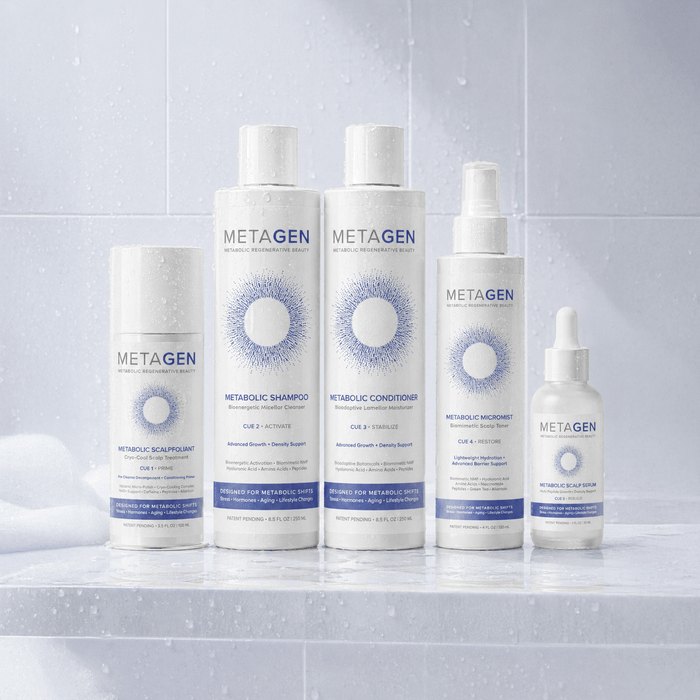
The Metagen routine: skincare for the scalp
Metagen was created as a scalp-first system for people experiencing visible hair and scalp changes during GLP-1 use, weight loss, stress, and metabolic shifts.
The routine is designed to work across multiple cosmetic needs:
Scalpfoliant: helps reset the scalp before washing by removing buildup and helping the scalp feel cleaner, fresher, and less congested.
Shampoo: gently cleanses while supporting the look and feel of scalp and hair vitality.
Conditioner: supports softness, comfort, barrier feel, smoothness, and the look of stronger hair.
Scalp Serum: targeted leave-on support for scalp comfort, visible density, and resilience appearance.
Micromist: lightweight daily scalp refresh and hydration support between wash days.
Together, the system helps support the scalp environment from multiple angles instead of relying on one product or one ingredient.
That is the difference between haircare and Metabolic Beauty.
Metabolic Beauty is the future of scalp care
The future of beauty is not just anti-aging.
It is adaptive.
It understands that people move through biological seasons:
Weight loss seasons
Stress seasons
Hormonal seasons
Postpartum seasons
Aging seasons
Medication seasons
Recovery seasons
High-performance lifestyle seasons
Each season can change what the scalp and hair need cosmetically.
Metabolic Beauty is built for that reality.
It is not about fear. It is not about telling people something is wrong with them. It is about giving people a smarter way to care for their scalp and hair when their body is changing.
The bottom line
Metabolic Beauty is the connection between internal change and external appearance.
It explains why your hair may feel thinner, flatter, duller, drier, weaker, or more fragile during GLP-1 use, weight loss, stress, hormones, aging, or other metabolic shifts.
It also explains why the scalp deserves more than basic haircare.
Metagen was created for this new beauty category: luxury clinical skincare for the scalp, designed to support the visible condition of hair and scalp during periods of metabolic change.
Because when your body changes, your beauty routine should evolve with it.
FAQ
What does Metabolic Beauty mean?
Metabolic Beauty means visible beauty changes that may happen when the body moves through internal changes such as GLP-1 use, weight loss, stress, hormonal shifts, aging, or reduced nutrient intake. It focuses on how the scalp, hair, skin, brows, and lashes can look and feel during these transitions.
Is Metabolic Beauty only for GLP-1 users?
No. GLP-1 users are a major focus because many people notice visible hair and scalp changes during weight loss. But Metabolic Beauty can also apply to stress, postpartum changes, aging, hormonal shifts, caloric restriction, and other lifestyle or body transitions.
Is Metagen a hair-growth product?
Metagen is a cosmetic scalp and hair system. It does not treat hair loss or claim to regrow hair. It supports scalp comfort, hydration, balance, visible density, shine, and the look and feel of stronger, more resilient hair.
Why does hair change during weight loss?
Hair can be sensitive to rapid body changes. Weight loss may be associated with reduced intake, lower protein intake, micronutrient shifts, stress signaling, and changes in how the body allocates resources. These factors can influence how hair looks, feels, and sheds.
Why is scalp care important for thinning-looking hair?
The scalp is the environment where hair grows. A dry, tight, oily, congested, flaky, or uncomfortable scalp can make hair concerns feel worse. Scalp care supports the visible condition of the scalp so hair can look and feel healthier.
What is the Metagen 5-Cue Method?
The Metagen 5-Cue Method is a patent-pending cosmetic framework that organizes scalp and hair support into five functional cues: Flow, Energy, Stress & Inflammation, Barrier & Microbiome, and Anchoring. The goal is to support the visible condition of the scalp and hair from multiple angles during periods of metabolic change.
Meet Metagen — the first scalp-first system created for the new era of Metabolic Beauty.
Metagen is external cosmetic care. This article is educational and is not medical advice. It does not diagnose, treat or cure any condition — sudden or significant hair changes should be discussed with a qualified health professional.